
The Right Conditions
Great startups ride shocks and shifts. A rare few create their own.

There’s a graveyard of startups who were right about the future but wrong about the timing.
Webvan and Instacart both bet that consumers would buy groceries online. The difference between an $11B market cap and zero? About a decade.
It’s why “why now?” is one of the most-asked questions in early-stage venture.
Founders often treat this question as fundraising theatre. Yes, having a good answer helps with raising capital. But understanding the answer is critical to building.
Market conditions come in two forms: shifts and shocks. Shifts build pressure slowly. Shocks cause the system to move. Great startups ride one. The best ride both. A rare few create their own.
Shocks
Shocks are sudden changes in a system that alter customer or market behavior.
During a shock, customers buy with an unusual sense of urgency. The risk is mistaking product-event fit for product-market fit. Customers may tolerate inadequate products or pricing in the short term. Only as the shock dissipates can a company see whether the product has staying power.
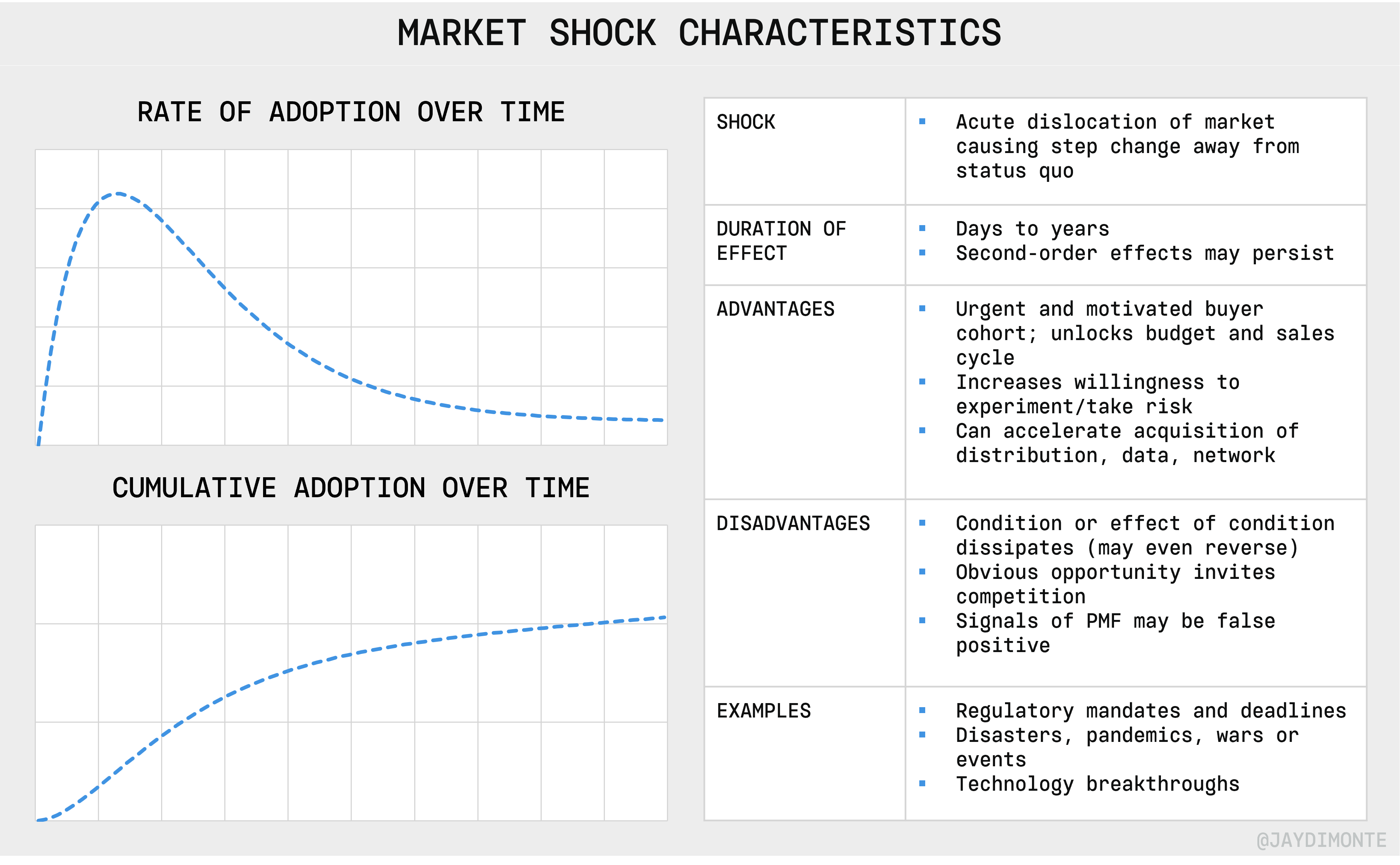
COVID was one such shock. The onset of social distancing spiked virtual communication.
Zoom was a beneficiary. Revenue grew from $623M in FY2020 to $2.65B in FY2021. And it stuck, hitting $4.9B last year and maintaining majority market share.
Clubhouse, a social audio network, rode the same wave but with a different result. Its monthly downloads peaked at 9.6M in February 2021, then fell more than 90% over the next two months.
Zoom used the shock to solidify its market leadership. Clubhouse depended on it to sustain user behavior.
Shocks work best as a slingshot. An affected company cannot rely on temporary tailwinds alone. It must leverage these to build durability (e.g. proprietary data, network density, or workflow ownership). The shock should explain how the company gets in, not why the customer stays.
Shifts
Shifts are tectonic changes in the structure of a market that build pressure over years.
They create inevitability without urgency. The market may be moving in the right direction, but not quickly enough to draw attention or drive action.
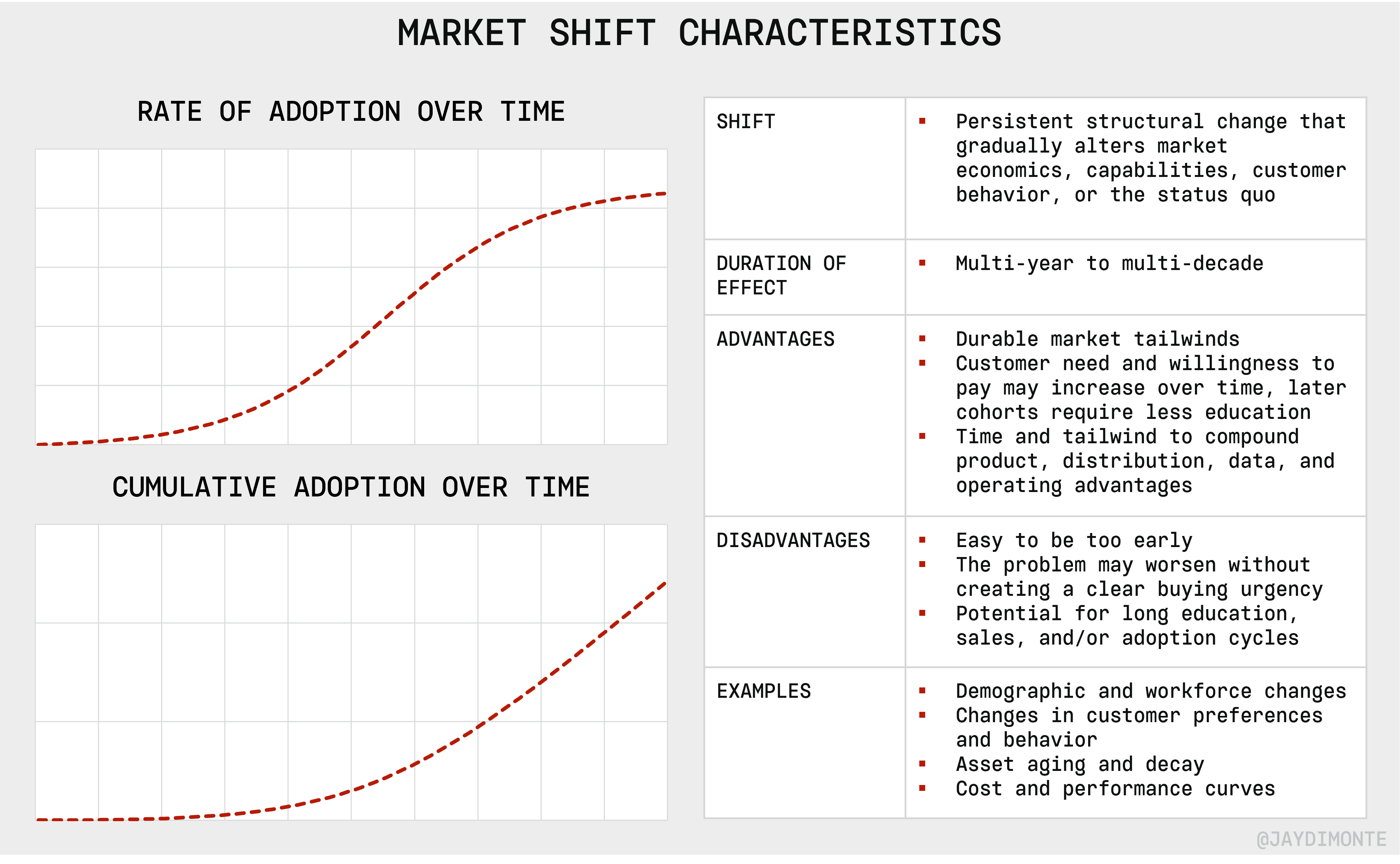
Google Glass and Meta Ray-Ban illustrate the cost of launching on different sides of a market shift.
Google tried to bring computing to the face. But it did so as hardware was still developing and consumer use cases still emerging. Admittedly, the design did it no favors.
A decade later, Meta Ray-Ban launched with the advantages of better cameras, batteries, and processor technology. Advanced AI enabled better UX. Photo and video-based social media gave consumers a reason to adopt.
The result is a spread measured in millions of units. The former, shut down, the latter sold 7M+ units in 2025 alone.
The key question is not whether the shift is real. It is whether the conditions have crossed the threshold to drive meaningful action.
When shifts meet shocks
The best markets have both a shift and a shock. The shock pulls early adopters forward. The shift puts lasting pressure on the majority.
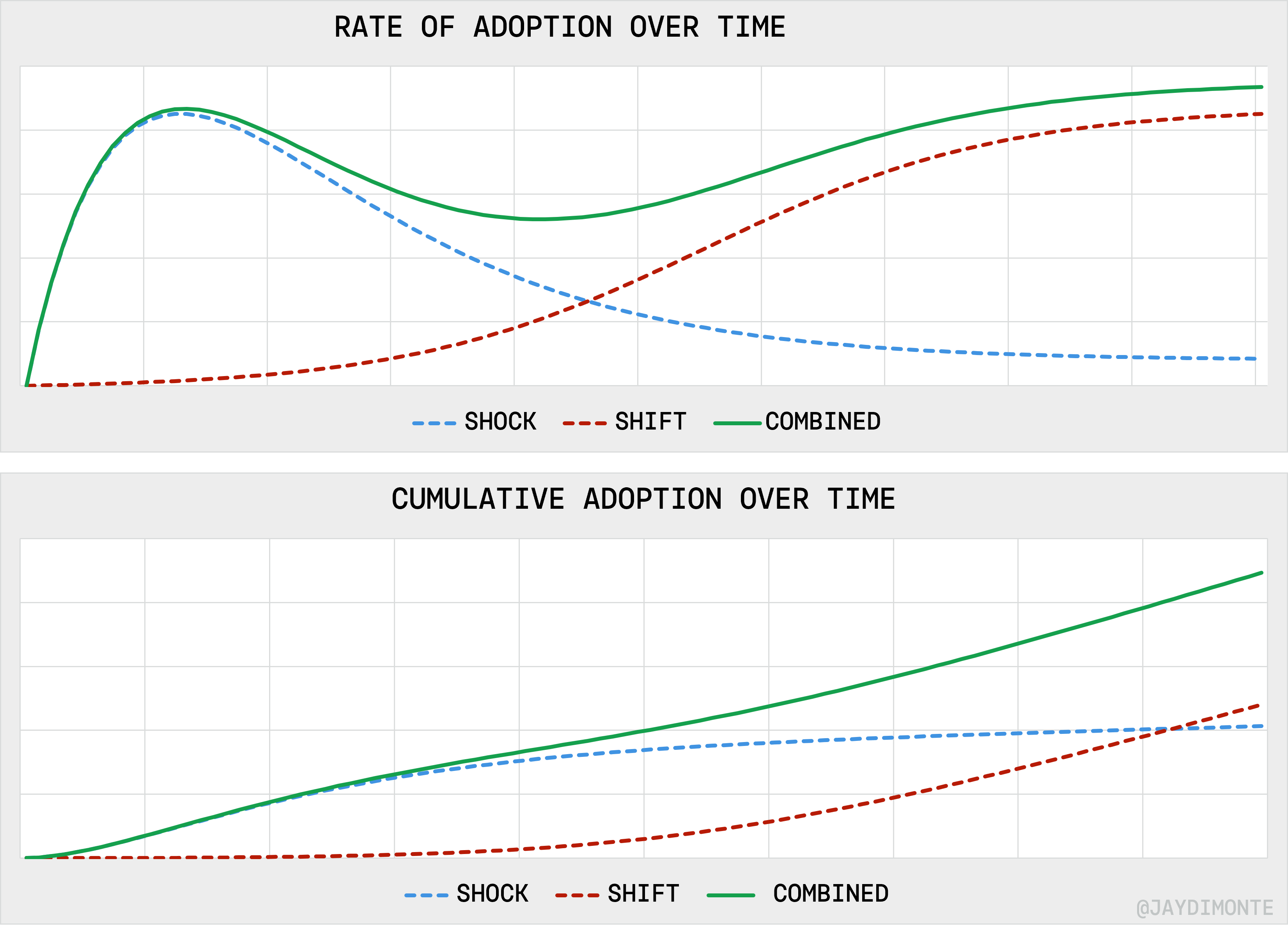
Consider the ELD (electronic logging device) mandate.
The market shift was technological. GPS, cellular connectivity, cloud software were enabling technologies.
A federal mandate shocked the system. Drivers needed to keep hours-of-service records electronically, replacing paper logs. A final rule was published in 2015 with a deadline to comply by 2017.
The transition created opportunity. Existing companies like Motive and Samsara added ELD compliance to their product suites. Emerging companies like FourKites and project44 used the new sensor infrastructure, aggregating data into real-time freight intelligence. Billions in enterprise value followed.
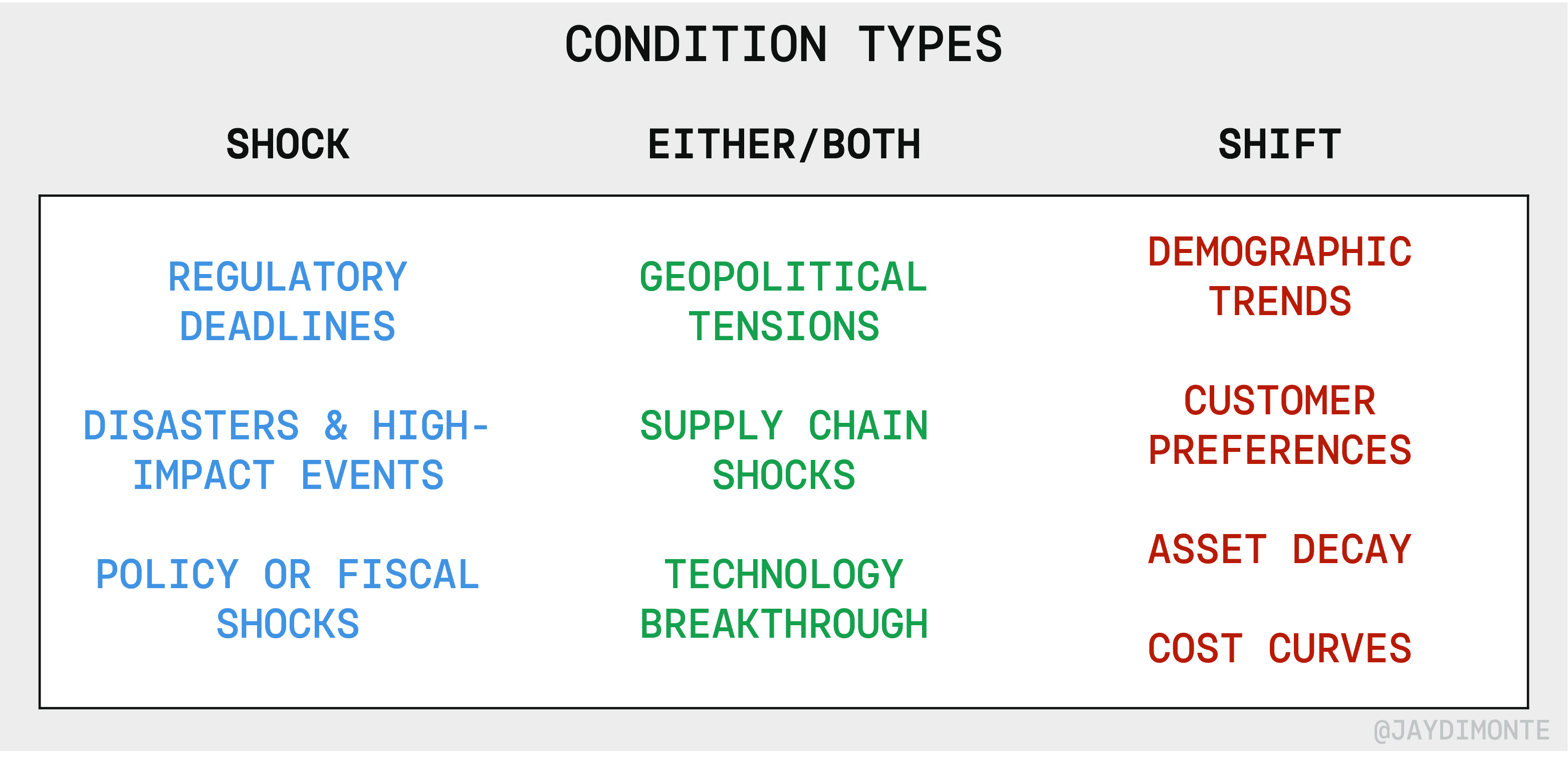
More recently, Base Power provides an example of the same pattern. Base deploys a distributed network of home batteries. During outages, the battery powers the home. During normal operations, Base helps balance the grid.
The market shift includes falling battery costs and aging, capacity-constrained grid infrastructure.
The shock was a disaster. Winter Storm Uri left many Texans without electricity for days. (Our house went without for five!) Hard to forget the associated damage, lost productivity, and health scares for the very young or old.
Base founder Zach Dell points to this event as an impetus for starting the company. It’s an impetus for many early adopters as well.
Condition takers or condition makers
Most startups react to conditions, but a small number create the condition themselves.
OpenAI shocked the market.
The impact of ChatGPT’s public release was immediate. Wrappers and other applications flooded the market. AI became a board-level priority overnight. The launch did not simply capture latent demand, it created it.
SpaceX created a market shift.
SpaceX spent 20 years opening the space economy. As the company lowered launch costs and increased cadence, some business models tipped from nonsensical to viable, others moved from niche to mass adoption. Still the effects continue to compound: first communications and observation and now the prospect of manufacturing and data centers.
Some companies open new markets. They must be led by founders who see the future and define their role in creating it.
A view from the early stage
At Grid, we care more about conditions than categories.
Categories describe where value sits today. Conditions indicate where it may be tomorrow. As early-stage investors, the distinction is consequential.
It’s one of the reasons why early-stage funds specialize. Focus keeps your ear to the ground. Shifts feel more tactile. Shocks are louder. The risk, of course, is an echo chamber. But the hope is to identify inflections before obvious.
Difficult in today’s market:
First, it’s easy to confuse conditions. A technology shock can look like a broader market shift. AI may create immediate product demand without corresponding durability. Instead look for AI shocks paired with underlying market shifts.
Second, VC attention spans are shorter than market cycles. In today’s concentrated market, outsized attention coalesces to the most consensus thing. That thing may or may not correlate with the wave you’re riding. Companies following shifts need investors aligned with the market’s actual pace. Companies riding shocks need enough durability/runway to survive the hype cycle.
Third, companies that create new market conditions will arise. Have the foresight to back them when possible. Otherwise, look for the derivative markets, infrastructure, and picks-and-shovels opportunities that emerge.
Our goal is to invest before the category is obvious, but when conditions are real.