

The power law is intensifying. Round sizes are growing. Companies are waiting longer to raise. There’s no shortage of outcry on the state of the venture market.
There’s causation and correlation and reinforcing cycles. But whatever the catalyst, the result is hard to argue with. Seed is the new Series A. A is the new B. And so on.
On one hand, what’s in a name? On the other, names set expectations. And expectations for what makes an acceptable Series A investment dictate who gets funded. For most venture-backed companies, funding is survival.
When the name changes, the bar changes. And if you’re caught on the wrong side of that bar, survival gets much harder. That is the market today.
The median (average) Series A has gone from $4.5M ($8M) ten years ago to $10M ($18M) five years ago, to $19.4M ($32M) today. 4x over the last decade, 2x over the last five years.
When rounds outgrow funds
There’s a natural relationship between round size and fund size. As rounds get bigger, funds need to be bigger to run the same strategy. As funds get bigger, they can lead bigger rounds.
When this flywheel spins a few times uninterrupted, you get to today’s market. Many Series A rounds are now large enough that only the largest funds can lead them.
To illustrate, I calculated the required fund size to lead each round by assuming a portfolio size of 20, a lead check that represents 70% of the median round, 30% reserves, and 20% fee load. What we get is the approximate fund size required to lead rounds by stage.
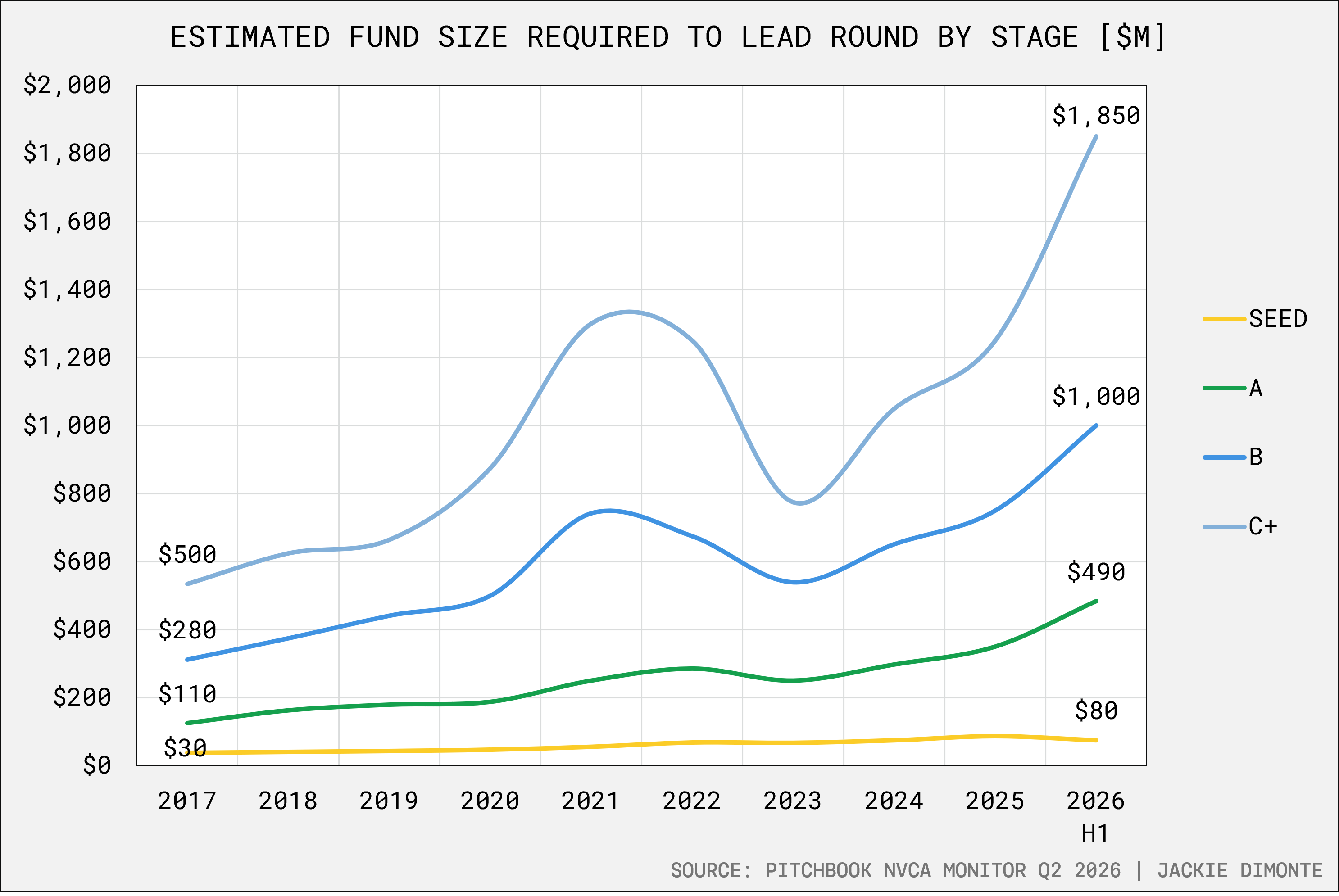
Let’s extend the illustration. Using fund size alone, how many funds closed each year were large enough to lead a typical Series A? This does not account for stated strategy or actual investment behavior, so analysis is simply directional.
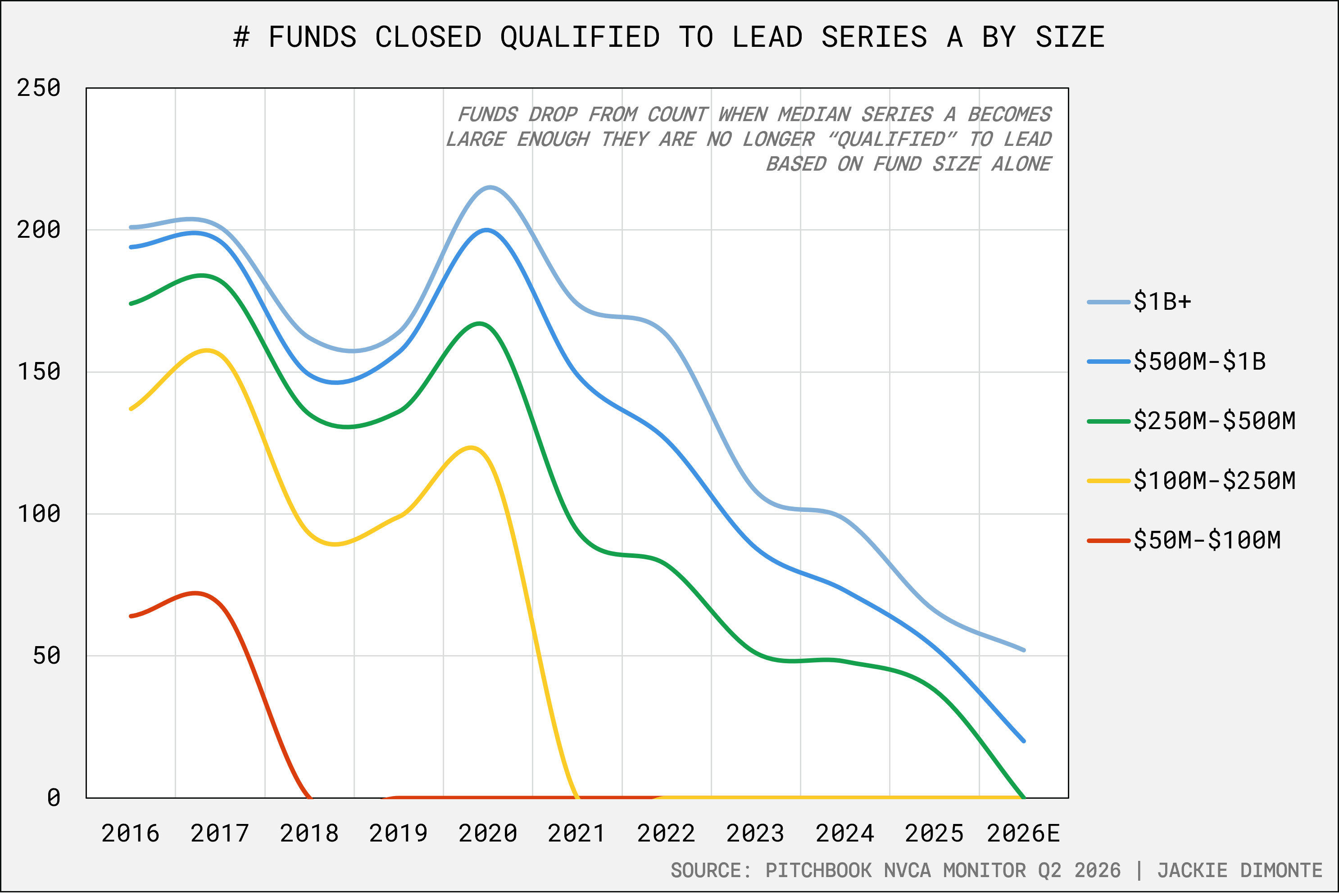
Under this framework, ten years ago, 200 funds closed that could lead Series As. Today, that number is 50.
That’s 1/4 the rate of Series A funds closing today.
And the difference may be even greater in practice. Fund cycles shortened from roughly three years to two over this period, so the relative pool of active Series A investors may be smaller still.
The funds that were no longer big enough to lead As didn’t disappear. Many firms that historically invested across seed/A concentrated more activity at pre/seed. Other seed funds grew larger to fend off downstream pressure. Today, its not unusual to see $250–500M seed funds (e.g. Pear, First Round, Lerer Hippeau, Primary, etc.). A decade ago, funds of that size would have looked much more like Series A/B vehicles.
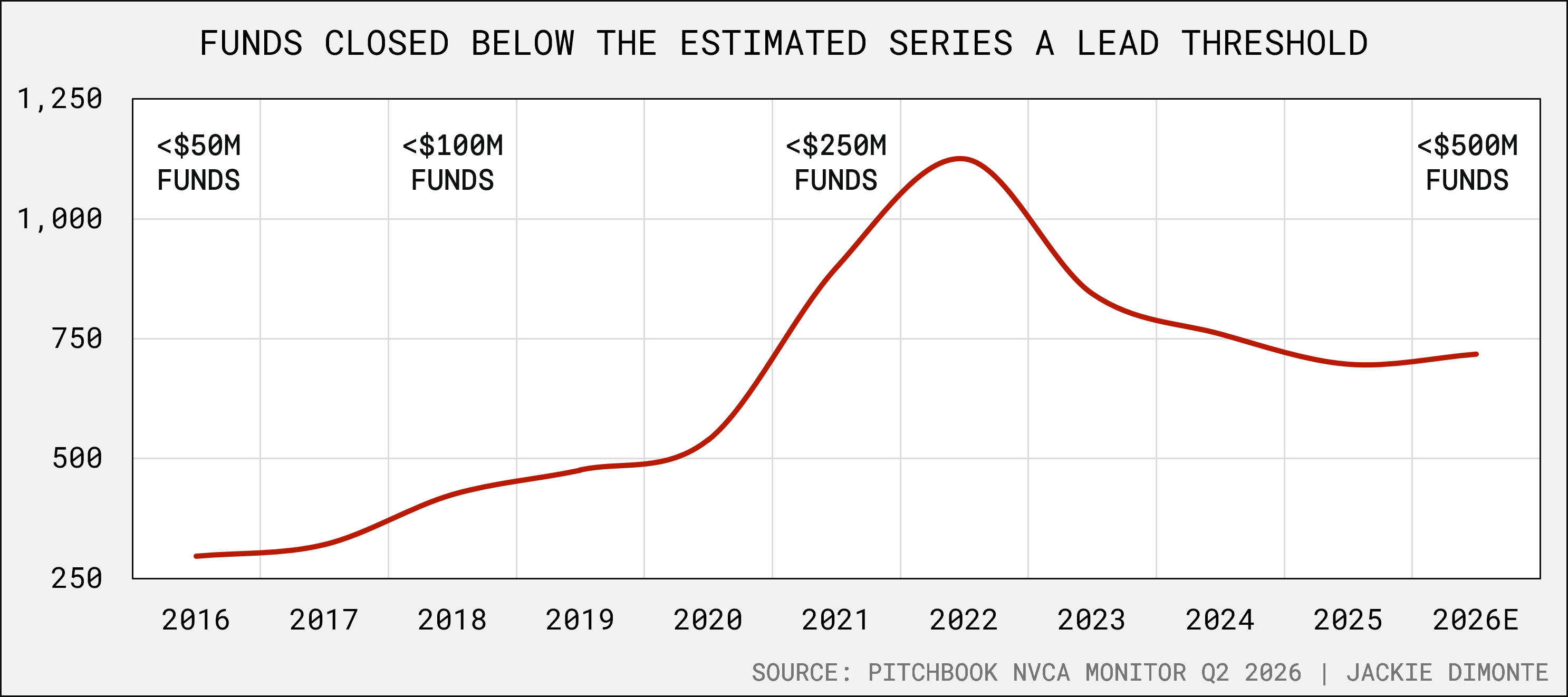
This is the crux of the barbelling. As Series A s grew in size and price, much of the market refocused on earlier stages. The chart above includes both sub-$50M funds and funds that effectively “dropped out” of Series A due to size. The result is a much different pool of funds sized to invest at pre-seed and seed, the opposite of what happened at A.
Pre-seed may have seen the most dramatic expansion. The number of sub-$50M funds have roughly doubled while $50-100M funds (post-seed and early A funds of 10 years ago!) look like pre/seed funds today. Though not explored here, we are seeing a similar “crunch” from pre-seed to seed. This is one reason why.
There we have it. More funds, though not necessarily capital, at the pre-seed stage. Fewer, and larger, at the Series A and beyond.
Compared with recent history, this makes the Series A market:
Less liquid - fewer capital suppliers
More consensus - flight to large TAMs, extreme growth rates, and legible founders / narratives
More barbelled - Series A companies increasingly need to be either extraordinarily quantitative or extraordinarily qualitative: 10x growth on one end, or little revenue but an enormous AI/ambition narrative on the other. It’s not always clear what defines extraordinary or if that ties to reality.
The companies most at risk are the ones in the middle. Good or great businesses but lacking obvious “extremes.”
What the barbell breaks
The product-market-fit logjam
This is the most obvious consequence. Gil Dibner summarized it well: Series A investors are increasingly investing either before there is meaningful evidence of PMF or well after the evidence is already overwhelming, leaving fewer investors willing to underwrite the messy transition in between.

A frequent complaint: companies with $3–5M in revenue growing 3–5x YoY passed over for either (A) companies with little/no revenue but take-the-world ambition, or (B) companies already growing 10x+ YoY.
That leaves a chasm for companies that look great by historical standards but do not clear the bar today.
Fewer Series A investors also means less diversity of underwriting. Fundraising is often about finding fit. E.g. what is in the top 5% of my deal flow may not be in the top 5% of yours, even if we are looking at many of the same companies.
When the pool of investors shrinks and the remaining firms increasingly look alike (e.g. size, focus, geography), the market becomes less liquid. There are fewer capital suppliers, but also fewer definitions of what qualifies as fundable.
The small fund paradox
As fund size scales so do the required outcomes to “return the fund.” So, while a $1B fund may need a $10B exit, a $50M fund may require only $500M exit. There are many more ways to exit for $500M+ than there are for $10B+. (And when a small fund hits the $10B exit, it’s extraordinary.)
But small funds are rarely the last investors in a company and rely on downstream investors. Small funds must consider the $10B+ narrative follow on capital requires, even when their own economics don’t.
When fundraising distorts the business
At times there is tension between what is good for narrative and what is good for business.
Today, there is much more room for this conflict. Most of it comes down to stage versus vision, TAM, and speed.

Larger funds at earlier stages mean a greater emphasis on scale earlier in a company’s lifecycle. It used to be that pre/seed was for finding evidence of PMF, A was for demonstrating repeatability, and B+ was for scaling. Increasingly, those are all expectations for raising a Series A.
You need a large opportunity and potential to capture it faster than anyone else.
That can pull founders into narratives they do not yet have full confidence in. Higher risk, higher reward.
How the market adapts
It does feel broken.
Markets are usually good at exploiting obvious gaps between price and value. Today’s constraint is opportunity cost. Consider the expected value of a dollar in Anthropic’s Series F or G versus almost any seed company.
You could conclude this is simply the new normal and there is no fighting the power law. Just give up, so to speak.
But markets are markets and I think they will adapt.
The return of the Series A craftsmen
Expect to see more sub-$100–200M funds running concentrated strategies to lead $5–20M Series A rounds. Where a traditional portfolio may hold 20–25 companies, these funds may back 5–15.
Some will compete head-on with Tier 1 firms. Many will target high-quality opportunities that fall outside the scope.
They win through concentration: time, attention, enough dollars at work that they’re aligned with the founders they back.
Seed funds move downstream
Following in mega-fund footsteps, additional capital deployed as reserves into leading As and subsequent rounds. Eventually, they pre-empt the As of seed rounds they missed.
Smaller funds may act big through use of SPVs.
PE becomes AI exit market
PE has its own liquidity problem as hold periods extend and exits, though rebounding, are concentrated in mega-deals. In the middle, legacy software assets are looking for new sources of narrative and growth. Operating businesses, margin expansion.
VC-backed companies now span software, hardware, and services. Many natural PE-backed buyers equipped to scale those business models.
Consider companies today, especially software, getting further, faster. There may be attractive off-ramps available at a different stage than historically expected.
When the ceiling falls
The market’s global high-water mark often turns out to be a local peak. Uber and WeWork set the ceiling in 2016. Valuations then fell back into the $25–50B range until Stripe reached $95B in 2021. Again, peak valuations fell after. OpenAI kicked off the new wave of highs in 2024, continued by Anthropic and SpaceX.
What happens after those companies exit?
History suggests the ceiling does not simply rise year after year. It falls back between heat cycles. If the next cohort’s high-water outcomes are $10–25B, expectations for earlier-stage companies should reset with them.
We may already be seeing some acknowledgement of that. Stripe agreed to acquire OpenRouter for $8B, while Nvidia is reportedly buying Hugging Face for $13B. Both celebrated as great outcomes, even while trillion-dollar possibilities sit above them.
Return of “rise of the rest”
In the late 2010s, nearly every Tier 1 developed some version of a geographic strategy. Part of that was simple competition. The Bay Area was crowded, and junior partners needed a way to carve out an edge.
That made second-tier markets attractive. A junior partner could build a differentiated network and their firm’s brand was strong enough to get them into virtually any room.
We may see a version of that again. Not by geography, but rather sector or company profile. Primarily around companies that fall outside today’s definition of “obvious” Series A quality.
As Tier 1 teams turn over (upcoming liquidity may assist), new partners will emerge. They’ll have an incentive to search where storied partners are not, and that will be outside consensus areas.
In highly consensus markets, alpha gets competed away.
Today’s venture market is moving in that direction: more capital chasing a narrower definition of what qualifies as a venture-scale business. As that definition narrows, more companies fall outside the jetstream. Valuable businesses get hindered by fundraising dynamics rather than business fundamentals.
If there’s anything to be learned in this business it’s that change is constant and markets excel at exploiting opportunity. Adaptation may take time, spurred by new fund cycles or a recasting of opportunity costs. But tomorrow’s Series A market won’t look like today’s.
The Macro here is different, not a new Cycle, a completely new reality.
That reality threatens the presumption of Alt. returns, but it questions if Pre-Seed or little "a" is functionally capable of capturing new Enterprise Formation creation, in a rationally timely manner.
I am very old, so when I draw this picture, I have to do some context.
In the historical documentary Butch Cassidy and the Sundance Kid, there is a scene where our heroic duo are trying to get hired, or funded if you will. The hiring manager, brilliantly acted, knows what he wants, someone who can shoot straight, he outlines a test, and asks legendary Gun slinger Sundance to draw his Colt and hit the rock. The Kid fails, flummoxing Butch, but irritating The Kid. As the hiring manager walks off in disgust, The Kid delivers a key line, " Can I move", he asks the hiring manager, who says "What" ....and the Kid pulls his Colt in a holster draw....and proceeds to hit the small rock multiple times.
Today, we are asking Founders to hit a rock, we need to say, but you can move, adapt, or promise us Capital providers, that you will do what it takes to keep up with a period of great prosperity, with a repricing capital return market, in a world teetering on a Multi Front World War, and Resource and Supply Chain dislocation.
The only Future that can contain that Risk and potential return is Venture Debt.
Forget the Foreplay and the Dance, if you believe, borrow it, and understand you fail and I own it.
Get to V.1 and maybe even a definition customer, a proven cost and pricing model, and we can convert to equity, as true partners.
This Is The Way. Jay.