
SaaS Was Never About the Software
What the "AI-kills-SaaS" narrative gets wrong

Last week, $300B of SaaS market cap evaporated in a matter of days, marking the start of the SaaS-pocalypse. Naturally, AI was to blame. Never again will growth rates resume. Market sizes have permanently shrunk. The era of high-margin recurring revenue is over.
It’s a compelling story. It’s also wrong.
Not because SaaS is immune to disruption. Incumbents need to innovate. Per-seat pricing needs to update. Of course.
It’s wrong because it misidentifies what SaaS actually sells.
SaaS was never about the software
SaaS is different from the on-prem model that came before it in two ways:
First, the business model shifted from one-time license purchases to subscriptions. Spend shifted from capex to opex and became more predictable. Per-seat pricing aligned cost with perceived value.
Second, the product shifted from software you installed and maintained to that delivered as a managed service. Updates, uptime, security, and infrastructure became the vendor’s responsibility. Pooled R&D allowed for better product delivered faster and frequently.
Both attributes contribute to why the model took off. Neither explain why it’s so entrenched today.
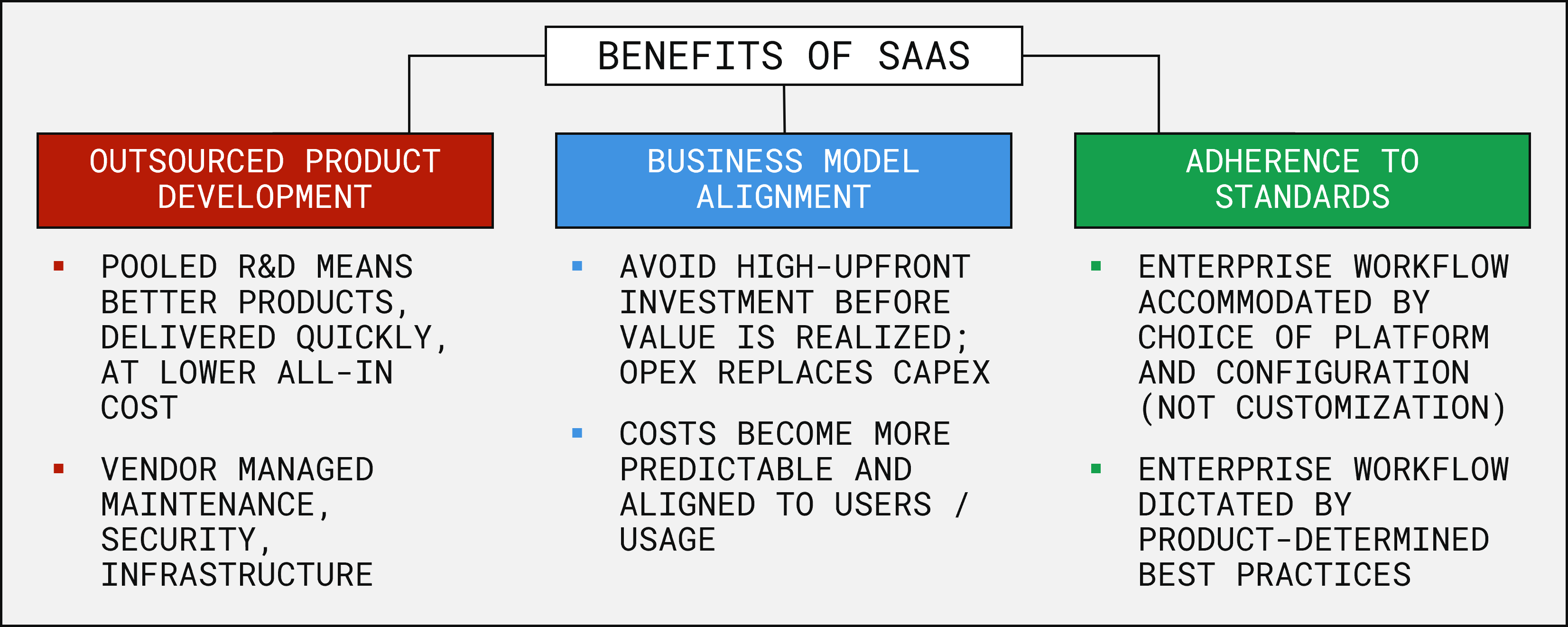
SaaS forces adherence to a standard structure and thereby limits the scope of decisions any enterprise needs to make. This is a key benefit to enterprise SaaS.
Before SaaS, every deviation from standard required custom code. Basic workflows came off-the-shelf. But when it came to company-specific processes, customizations happened directly on the codebase. That, or IT spun up purpose-built apps and integrated into the main system. This led to bloat, IT burnout, and a lot of organizational and technical debt
SaaS collapsed this IT sprawl into structure. Enterprises got configuration, not customization. Many times, when software structure and company workflow conflicted, the software won.
SaaS was not just better, cheaper, faster software. It delivered a set of rules and norms that told IT and business users how to implement best practices.
Code was not the constraint
The constraint is deciding what the code should do and making sure it did that thing. In enterprises, that means engaging folks with different incentives, priorities, and political capital... and getting them to agree.
Early in my career I ran ERP upgrades, consolidations, and cloud migrations for energy companies. Even then, a 10+ years ago, the actual build was a fraction of the total project time. Requirements gathering took months with dozens of user interviews, design sessions, process reviews. Often, organizations used these projects to assess resourcing and streamline workflows. The alignment was the point.
For example though Palantir claims their AI can compress that process from six months and six million dollars to sixty seconds, will that make projects six months shorter? Or does the time saved in build get shifted to design and test?
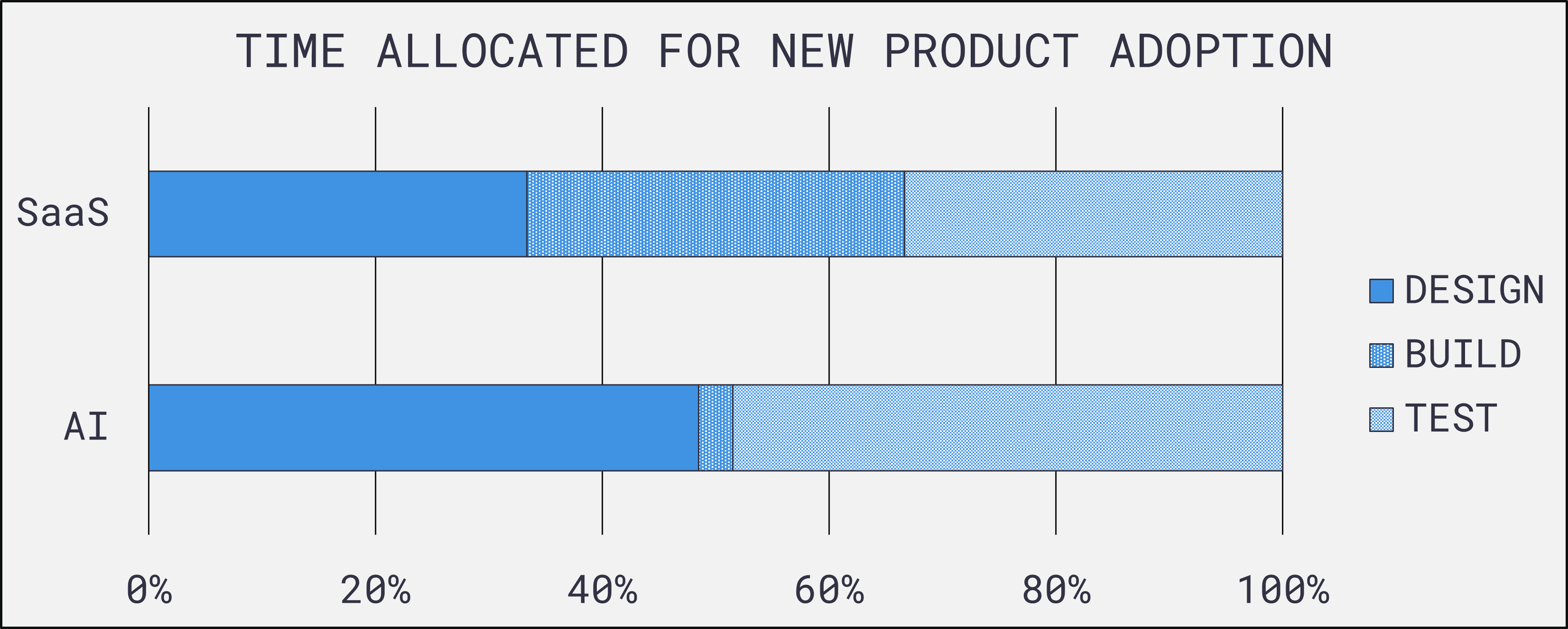
AI expands the decision surface. As AI makes building cheaper and faster, the design-phase expands. Suddenly every system and every process is up for grabs.
That means more stakeholders, more meetings, more buy in.
When you can build anything or migrate anywhere at near-zero cost, the question shifts from “can we?” to “should we?” Do you need another custom workflow optimized around a sub-optimal process? Do you need to relitigate what is a qualified lead?
AI introduces the need for more validation and change management. When AI is running migrations or building the systems, who validates the work? Do we end up spending more time on testing and change management? Who tells the employee, already skeptical of the system, that the AI got their payroll calc right?
Or is the entire point of SaaS that someone already solved these issues, and enterprises can just move on?
AI as never the (existential) threat to SaaS
A bold statement, but shaped by:
The value of SaaS was never about the software. As explained above.
We don’t actually spend that much on SaaS on a relative basis. Per Zylo, companies spend an average of $11.5K per employee on software. Compare that to the average white-collar employee salary of $122K.
Legacy SaaS and enterprise AI have distinct advantages, and the smartest people “get it.” The earliest adopters in enterprises will not spend time reinventing the wheel. Instead, big wins will come from implementing AI where it is best suited. They’ll go for the “wow” factor. This will tend to systems of decision, action, and creation... not replication.
Then the natural conclusion is less that AI will crush legacy SaaS and more so that is will profoundly impact our workforce. The narrative supports it. There are hundreds of announcements of AI-fueled workforce slowdown. And yet, there weren’t a long line of cancelations after Klarna famously fired Workday in 2024.
SaaS is consultants. AI is workforce. Both have a place.
If you believe AI kills SaaS, you’re betting that the value in enterprise software is the code.
It isn’t.
To hammer home the point, consider the framework:
SaaS = consultants. Shared resources that are bastions of best practices. Onboarded to reduce rework, outsource risk, and regulate cost.
AI = workforce. It executes. It takes direction and produces output. It replaces labor at the task level: analyzing, deciding, producing. The value is in action and the cost is too.
Organizations cannot function without the output of employees (for now!). They hire consultants for best practices (and political cover). But consultants don’t replace employees (and vice versa). In the same way, AI will turbocharge execution, but it won’t remove the need for a system of record and a system of rules. These records and rules are best managed by structured, deterministic systems.
I love how you explain why SaaS remains relevant. Do you have a watchlist of companies that best fit this thesis? I’d love to discover a few names I’m not familiar with yet.
This is great!